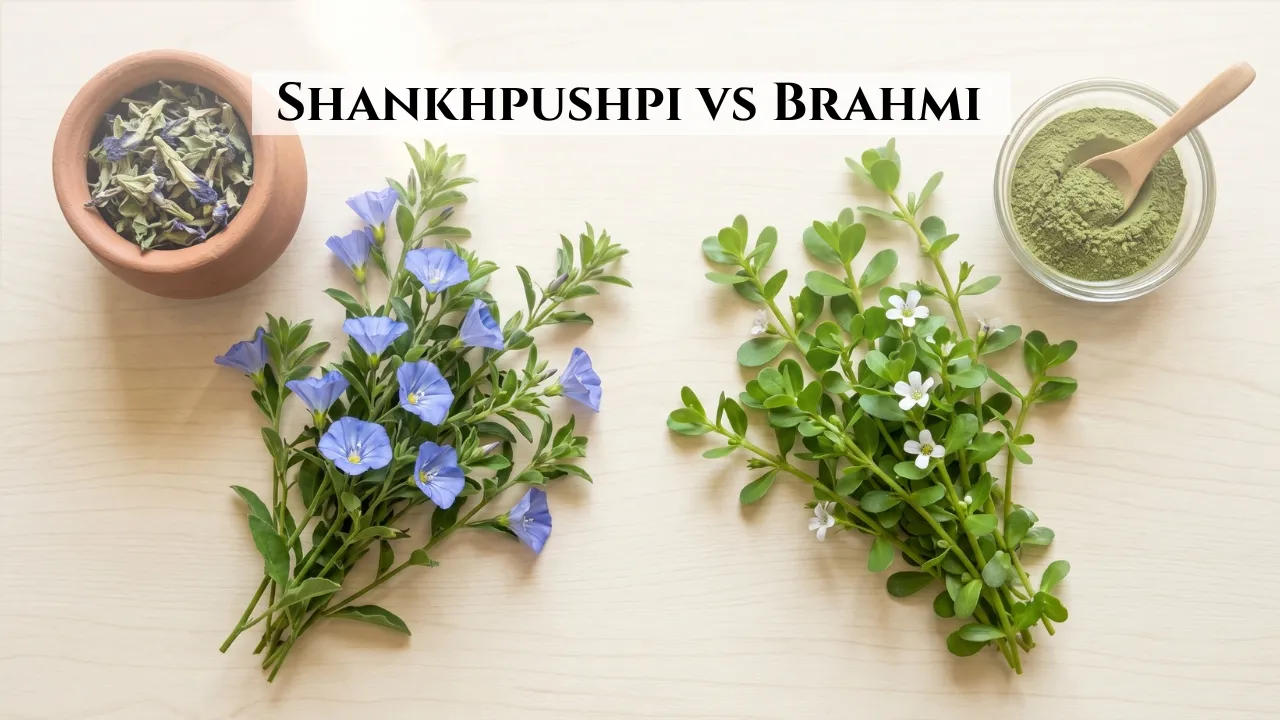
Brahmi has been sitting on Ayurveda’s shelf for thousands of years — right next to Shankhpushpi. Most people have heard both names. Some have even tried one of them. But almost nobody actually knows which one does what. Both are Medhya Rasayana herbs, which means Ayurveda specifically classifies them for brain health — memory, focus, and mental clarity. The thing is, they are not the same. Not even close. One calms your mind down. The other sharpens it. And picking the wrong one means you probably won’t see the result you were hoping for. This is that comparison.
What is Shankhpushpi?
Shankhpushpi (Convolvulus pluricaulis) is a small creeping herb with pale blue flowers that grows across the Indian subcontinent. It has been part of Ayurvedic practice for centuries — the Charaka Samhita, one of Ayurveda’s oldest foundational texts, lists it as a primary Medhya herb, meaning it directly supports brain function.
But what makes this shankhpushpi ayurvedic herb different from others is its core action — it does not stimulate the brain, it settles it. People who deal with constant mental chatter, restlessness, or stress-driven forgetfulness respond well to it. Shankhpushpi for stress and anxiety is where it genuinely performs. Its active compounds — flavonoids, alkaloids, and glycosides — work on the nervous system, slowing down the overactive mind without making you drowsy.
The shankhpushpi benefits for brain include:
- Reduces anxiety and mental tension.
- Improves sleep quality, which directly supports memory.
- Helps with stress-related forgetfulness.
- Supports focus in people whose concentration breaks due to overthinking.
What is Brahmi?
Brahmi (Bacopa monnieri) is the memory herb. That is genuinely the simplest way to put it. While Shankhpushpi works by calming a restless mind, Brahmi works by making a calm mind sharper. It helps your brain hold on to information, learn faster, and stay alert for longer. The Ashtanga Hridayam, another classical Ayurvedic text, specifically recommends it for improving intellect and retention. Students have been using it for centuries — not as a trend, but because it works consistently.
Its active compounds, called bacosides, repair and strengthen the connections between brain cells, which is why regular use shows real results in memory and learning speed.
Brahmi is particularly useful for:
- Holding on to new information and recalling it faster.
- Staying mentally alert during long study or work sessions.
- Rebuilding memory that has weakened over time.
- Supporting focus without causing restlessness.
Here is a simple side-by-side look at both herbs before we go deeper.
| Shankhpushpi | Brahmi | |
|---|---|---|
| What it does | Calms a stressed, overactive mind | Sharpens memory and speeds up learning |
| Best for | Anxiety, restlessness, poor sleep | Memory loss, slow recall, mental fatigue |
| Works best on | Adults and children dealing with stress | Adults, students, and elderly with memory concerns |
| Forms available | Syrup, powder, capsule | Syrup, powder, capsule |
| How fast it works | Noticeable calm within 2–3 weeks | Memory improvement visible after 4–6 weeks |
Which One Actually Works Better For You?
For Memory
If your main problem is forgetting things — names, tasks, things you just read — Brahmi is the answer. It directly strengthens the brain’s ability to store and recall information over time.
For Stress and Anxiety
When your mind will not stop running, Shankhpushpi is what you need. It lowers mental tension and calms the nervous system without making you feel sedated.
For Better Sleep
Poor sleep and a stressed mind usually go together. Shankhpushpi addresses both — it relaxes the mind enough to let you fall asleep naturally and wake up feeling rested.
For Focus and Studying
If you need to sit down, study, and actually retain what you read, Brahmi gives you that edge. It improves both concentration and how fast your brain processes new information.
For Kids
Both herbs are used for children, but Shankhpushpi is the safer starting point. It is gentler, works well for restless or anxious kids, and has a long history of use in children.
Who Should Pick Which One?
Choose Shankhpushpi if:
- You get anxious before exams or important meetings.
- Your mind keeps racing at night and sleep does not come easily.
- You feel mentally exhausted even without doing much.
- Your child is restless, hyperactive, or struggles to sit still.
- Stress is the main reason your focus and memory feel off.
Choose Brahmi if:
- You keep forgetting names, dates, or things you just read.
- You are a student who needs to retain a lot of information quickly.
- You are a working professional whose mental sharpness has started to dip.
- You are older and have noticed your memory is not what it used to be.
- You want to improve how fast your brain picks up and processes new things.
Can You Take Both Together?
Yes — and honestly, taking both together works better than picking just one. Shankhpushpi calms the noise in your head while Brahmi uses that calm to build sharper memory and focus. They do not overlap — they complete each other. Classical Ayurvedic formulas have combined these two herbs for exactly this reason. When the mind is relaxed, it absorbs and retains information far more effectively. That is the whole idea behind using them together.
- Both herbs are safe to combine with no known conflict between them.
- Together they cover both sides — mental calm and memory strength.
- Classical Ayurvedic texts support multi-herb Medhya formulations.
- Smaran Shakti syrup by Rosette Organics already brings both herbs together in one formula, along with Ashwagandha — so you do not have to figure out the combination yourself.
How Much Should You Take?
No guessing needed. Here is a straightforward dosage guide for both herbs across all common forms.
| Form | Shankhpushpi | Brahmi |
|---|---|---|
| Powder | 3–5g once daily | 2–4g once daily |
| Syrup | 10–15ml twice daily | 10ml twice daily |
| Capsule | 1–2 capsules daily | 1–2 capsules daily |
The best time to take either herb is in the morning on an empty stomach. If that feels uncomfortable, warm milk at night works just as well — and for Shankhpushpi especially, taking it with warm milk at night supports better sleep alongside the brain benefits.
So, Which One Should You Choose?
Both herbs are genuinely useful — they just solve different problems. Shankhpushpi is for the mind that needs to slow down. Brahmi is for the mind that needs to sharpen up. Here is the fastest way to know which one is yours.
| If you are… | Go with… |
|---|---|
| Stressed, anxious, or not sleeping well | Shankhpushpi |
| Forgetting things or struggling to focus | Brahmi |
| A student dealing with both stress and memory | Both together |
| An older adult with memory concerns | Brahmi |
| A parent looking for something safe for kids | Shankhpushpi |
If you want both benefits in one syrup, Smaran Shakti by Rosette Organics combines Shankhpushpi, Brahmi, and Ashwagandha — three herbs working together for a calmer, sharper mind.
FAQS
Q1: Which is better, Brahmi or Shankhpushpi?
Ans: It depends on what you need. Brahmi is better for memory and learning, while Shankhpushpi works better for stress, anxiety, and sleep.
Q2: Does Shankhpushpi increase brain power?
Ans: Yes, but not by stimulating the brain — it works by calming mental stress, which allows the brain to focus and retain information more effectively.
Q3: Is there any side effect of Brahmi?
Ans: Brahmi is generally safe, but taking it in high doses can cause mild digestive discomfort like nausea or an upset stomach in some people.
Q4: Who should avoid Brahmi?
Ans: People with very low blood pressure and pregnant women should avoid Brahmi without consulting a doctor first.
Q5: Does Brahmi lower BP?
Ans: Brahmi has mild blood pressure lowering properties, which is why people already on BP medication should consult a doctor before using it.
Q6: Who should not take Shankhpushpi?
Ans: People with low blood pressure and pregnant women should avoid it, and children should only take it in age-appropriate doses.
Q7: Is Shankhpushpi good for the liver?
Ans: Shankhpushpi is primarily a brain herb and not specifically used for liver health — for liver support, herbs like Kalmegh or Bhumi Amla are more suitable.